

Property Data with GPT
Build Datafiniti property queries with ChatGPT or Codex — in a plain conversation you run yourself, or through a connected tool call.
ChatGPT / Codex — Property Examples
ChatGPT connector awaiting OpenAI approval
The Datafiniti ChatGPT connector is still awaiting approval from OpenAI. Until approved, the MCP and tool/action integration paths described below may not be available in ChatGPT or Codex. The plain-conversation approach works regardless of approval status. You can also connect manually by configuring the Datafiniti MCP server yourself — see the MCP Server guide for instructions.
This guide shows how to get property data out of Datafiniti using ChatGPT or Codex. It leads with the plain-conversation path — where the model writes a query and you run it — then shows the connected form for when the model calls Datafiniti directly. For the three ways to wire this up (MCP, tool/action, or plain chat), see the ChatGPT / Codex page.
For the field reference behind these queries, see the Property Data Schema, Constructing Property Queries, and Possible Values for Property Fields.
The goal
We want single-family homes currently for sale in Austin, TX — and we'll have the model build the query, then run it ourselves.
Build the query in conversation
You don't need any integration. Paste in the property query guide and the possible-values page, describe what you want, and let the model draft the query.
You: Using Datafiniti property data, build me a query for single-family homes currently for sale in Austin, TX. Here's the property query guide and the possible property status values: [paste or link the guides]. Explain each part.
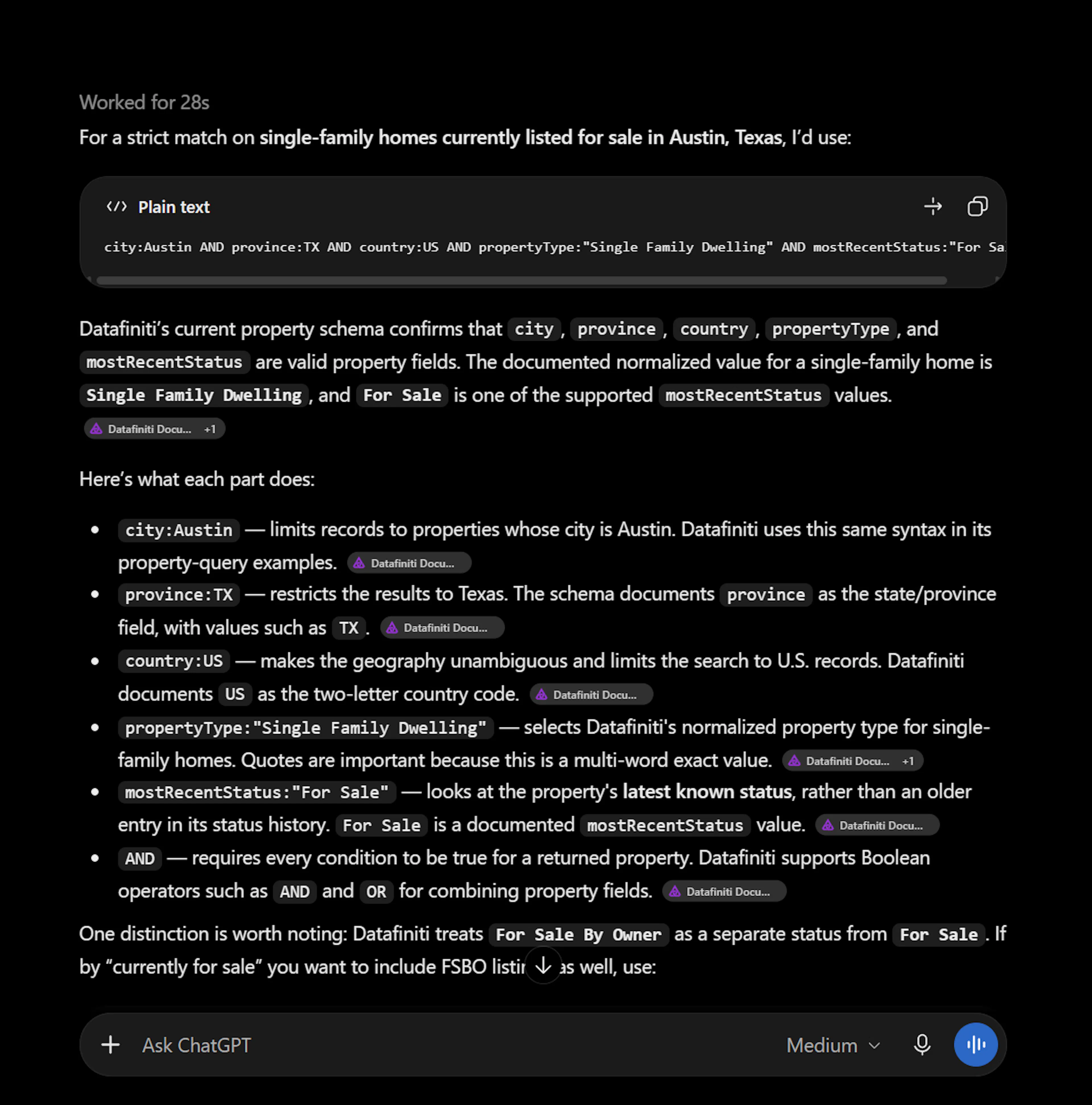
Model: Here's the query:
country:US AND province:TX AND city:Austin AND propertyType:"Single Family Dwelling" AND mostRecentStatus:"For Sale"
country:US AND province:TX AND city:Austinlimits to Austin, Texas.propertyType:"Single Family Dwelling"restricts to single-family homes — an exact value from the Possible Values page.mostRecentStatus:"For Sale"filters to active sale listings. (For rentals you'd usemostRecentRentalStatusinstead — a rental status on the sale field returns nothing.)
Give the model the right context
The model writes much better property queries when you paste in Constructing Property Queries and Possible Values for Property Fields. Without them it will guess field names like propertyType values or the status field, and property status in particular is easy to get wrong.
Run the query yourself
Take the query the model produced and run it in Postman, cURL, or an SDK. When you send it to the API, the exact-match values are double-quoted in the query, and if you're hand-writing JSON you escape those inner quotes:
{
  "data_type": "property",
  "query": "country:US AND province:TX AND city:Austin AND propertyType:"Single Family Dwelling" AND mostRecentStatus:"For Sale"",
  "num_records": 5,
  "view": [{"name": "address"}, {"name": "city"}, {"name": "province"}, {"name": "mostRecentPriceAmount"}]
}
In a plain conversation the model only writes the query — nothing is charged until you run it yourself.
Connected mode: let the model run it
If your ChatGPT or Codex environment has the Datafiniti MCP server connected (or the search endpoint registered as a tool), you can skip the copy-paste and ask the model to run it:
You: Count how many single-family homes are for sale in Austin, TX, then show me the first five.
The model calls df_count first (free) to size the result, then df_search for the sample. Under the hood those calls look like:
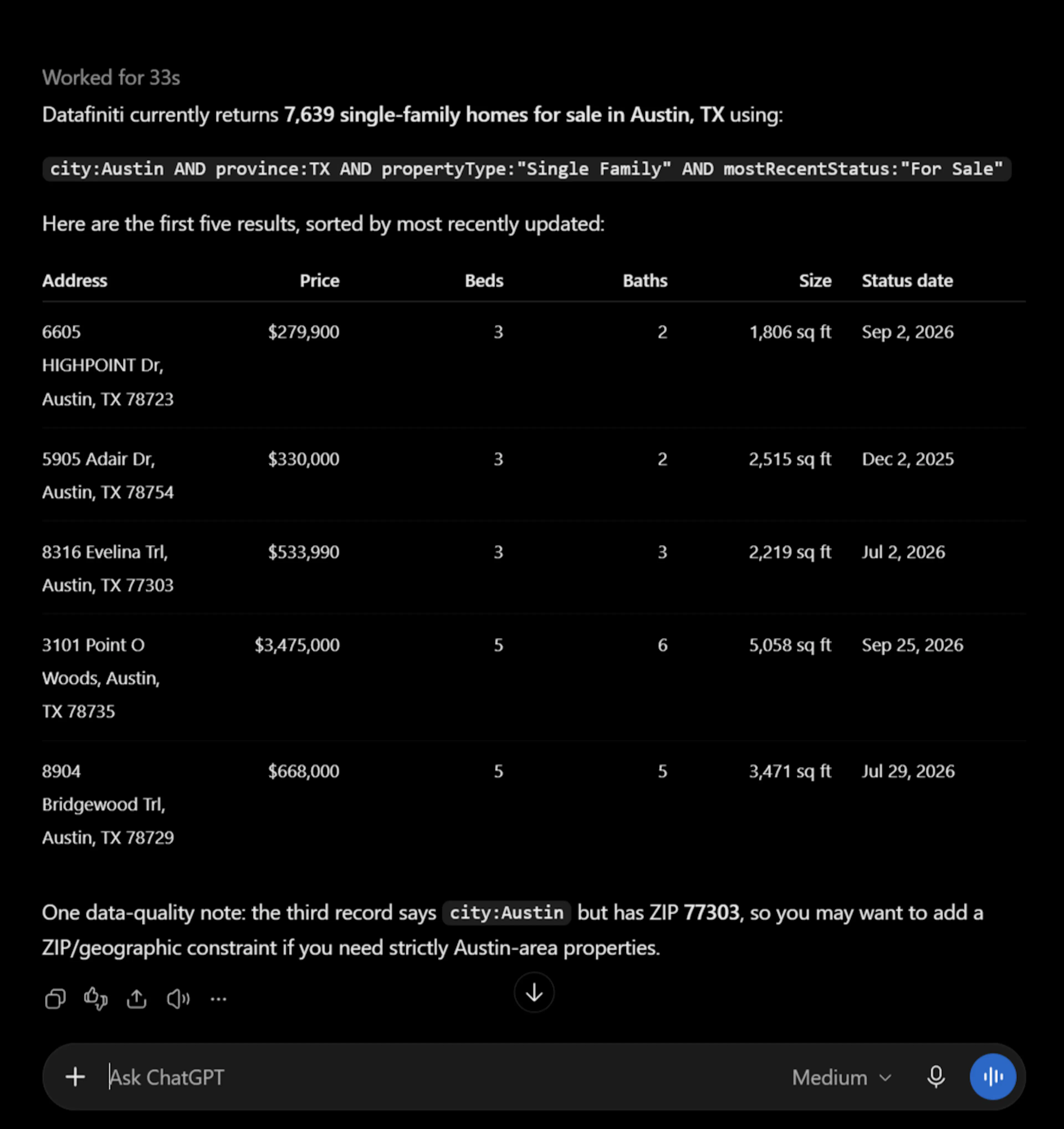
{
  "data_type": "property",
  "query": "country:US AND province:TX AND city:Austin AND propertyType:"Single Family Dwelling" AND mostRecentStatus:"For Sale""
}
Once connected, searches and downloads charge credits exactly as REST does. See MCP Server for the full tool reference, and Property Data with AI for property fields, statuses, and prompts.
Use case: discover when a client sold their home
A common real-estate workflow is watching a list of client addresses for a status change — so you can follow up when someone lists or sells. The Discover when clients sell their homes guide walks through this end to end; here's how ChatGPT or Codex helps you build the per-address check.
Say you have a client at 1023 Jollyville Rd, Austin, TX 78703 and you want to know whether their home has had a recent status change.
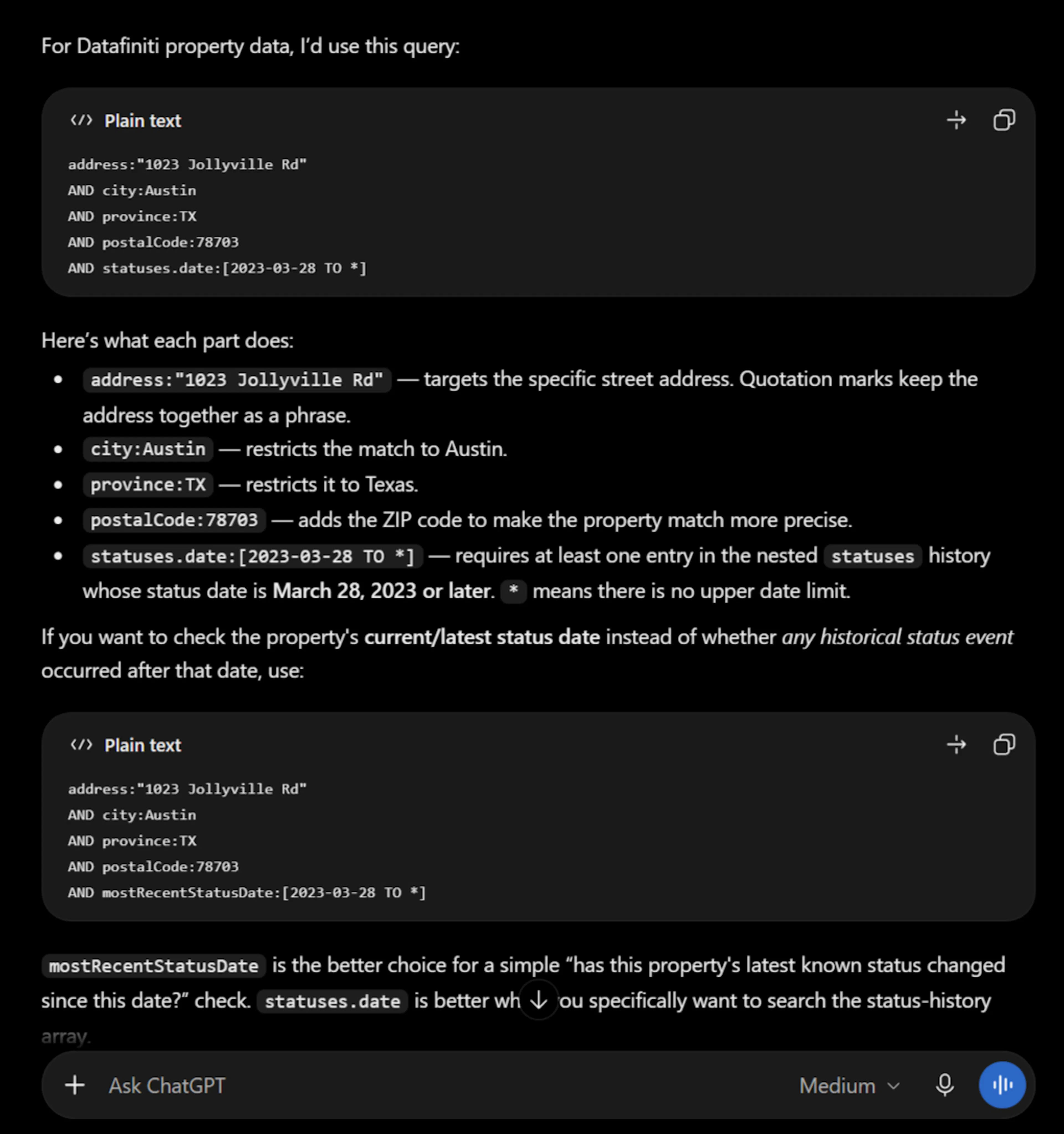
You: Using Datafiniti property data, build me a query that checks whether the property at 1023 Jollyville Rd, Austin, TX 78703 has had a status update since March 28, 2023. Here's the property query guide: [paste or link the guide]. Explain each part.
Model: Here's the query:
address:"1023 Jollyville Rd" AND city:Austin AND province:TX AND postalCode:78703 AND dateUpdated:[2023-03-28 TO *]
- The address, city, province, and postal code pin the exact property.
dateUpdated:[2023-03-28 TO *]is an open-ended range that only matches if the record was updated on or after that date — so a hit means something changed recently.- When a record comes back, read
mostRecentStatusandmostRecentStatusDateto see the new status and when it took effect.
To run this across a whole client list, loop the query over each address and advance the dateUpdated floor each day so you only catch new changes. If your environment has the connector, the model can call df_search per address directly; otherwise it builds each query and you run them yourself. For the full walkthrough — including turning the results back into a CRM-ready file — see Discover when clients sell their homes.
Next steps
- Same flow for Product or Business data.
- Wiring options: ChatGPT / Codex.
- Prefer Claude? Claude.