

Product Data with Postman MCP
Drive the Datafiniti MCP tools against product data by hand in Postman — count, search, work with nested fields, and start a download.
Postman — Product Examples
This guide walks through calling the Datafiniti MCP tools against product data by hand in Postman — selecting a tool, filling in its argument form, sending, and reading the response. It assumes you've already connected Postman to the MCP server and authenticated; if not, start with the Postman guide for download, token, request, and connection setup.
Everything here uses the same tools and data_type parameter as the other data types; what changes are the fields, nested sub-fields, and views specific to product records. For the field reference, see the Product Data Schema and Constructing Product Queries. For the full tool reference, see MCP Server.
The goal
We'll find Apple laptops with pricing and descriptions — first counting them, then pulling a sample, then working with nested fields and the compound query syntax, then exporting descriptions and reviews.
1. Count with df_count
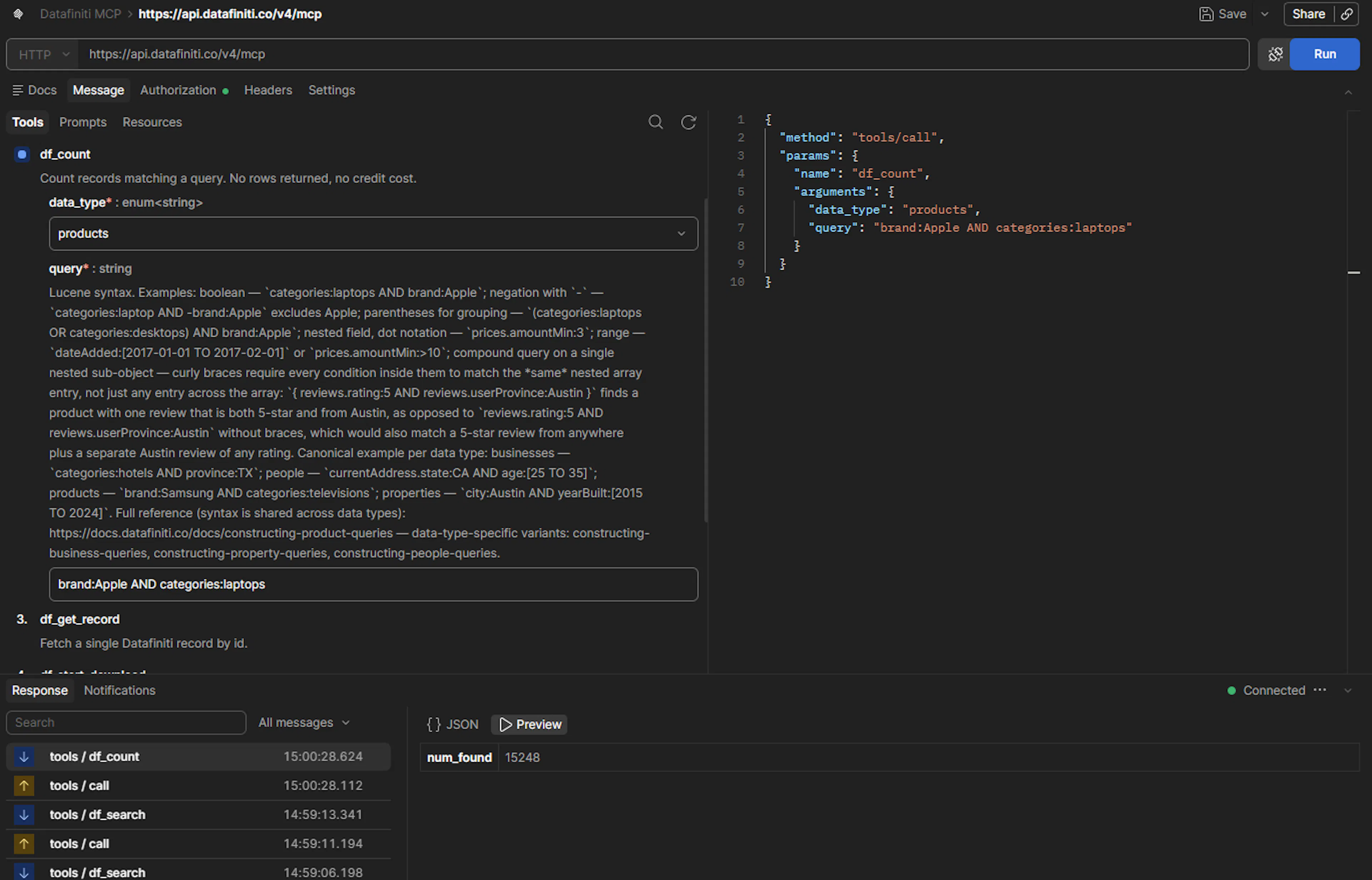
Select the df_count tool and fill in data_type and query:
{
  "data_type": "product",
  "query": "brand:Apple AND categories:laptops"
}
Send it. df_count returns a match count with no records and no credit cost:
{
  "num_found": 15248
}
Match multiple values in one field
Product queries often match several values in one field — group alternatives with parentheses, e.g. categories:(laptops OR desktops). A count of 0 is a valid result, not an error.
2. Search with df_search
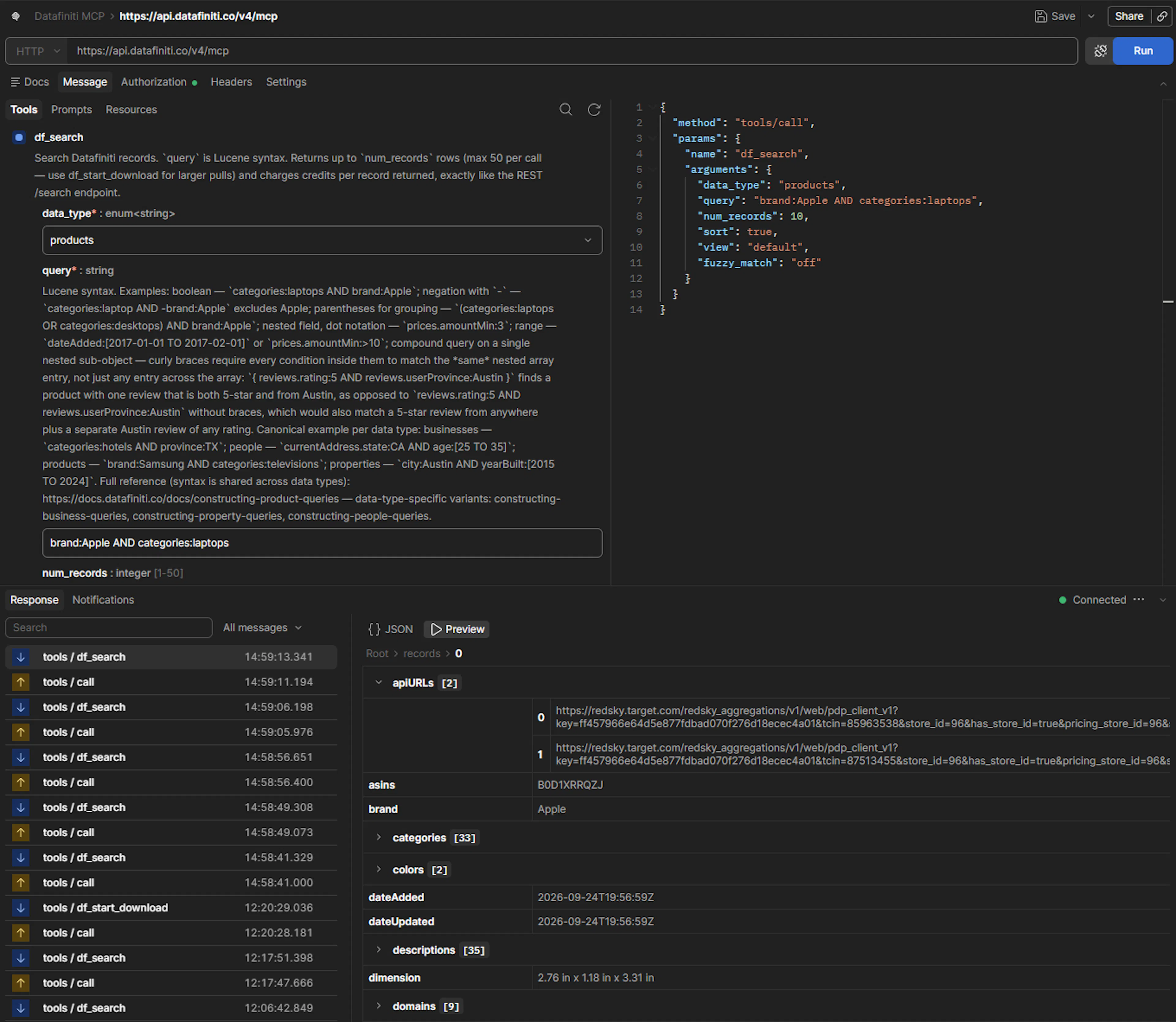
Select df_search. Add num_records and a view:
{
  "data_type": "product",
  "query": "brand:Apple AND categories:(laptops OR desktops)",
  "num_records": 5,
  "view": [{"name": "name"}, {"name": "brand"}, {"name": "categories"}, {"name": "prices.amount"}, {"name": "prices.currency"}]
}
Send it. The response has the same shape as a REST search:
{
  "num_found": 15248,
  "total_cost": 5,
  "records": [
    {
      "name": "…",
      "brand": "Apple",
      "categories": ["laptops"],
      "prices": [
        {"amount": "000.00", "currency": "USD"}
      ]
    }
  ]
}
3. Work with nested sub-fields
Product data leans on nested structures — prices, descriptions, and reviews are nested objects. Reference their sub-fields with dot notation, in both queries and views.
Query on a nested sub-field:
{
  "data_type": "product",
  "query": "brand:Apple AND descriptions.value:"Retina display""
}
Request nested sub-fields in a view with dot notation in the name:
{
  "view": [
    {"name": "name"},
    {"name": "brand"},
    {"name": "descriptions.value"},
    {"name": "reviews.text"}
  ]
}
Dot notation, not sub-field arrays
Nested sub-fields are expressed as dot notation in a view's name — "descriptions.value" — rather than a separate sub-fields array.
4. Use the compound {} syntax
To require multiple sub-fields to match within the same nested object — rather than anywhere across separate objects — use the compound {} syntax. For a product with a single price record that is both under a threshold and in USD:
{
  "data_type": "product",
  "query": "brand:Apple AND prices:{amount:[* TO 1000] AND currency:USD}"
}
This differs from an unbraced AND, which would let the two conditions be satisfied by different price records on the same product. See Constructing Product Queries for a full explanation.
5. Export with df_start_download
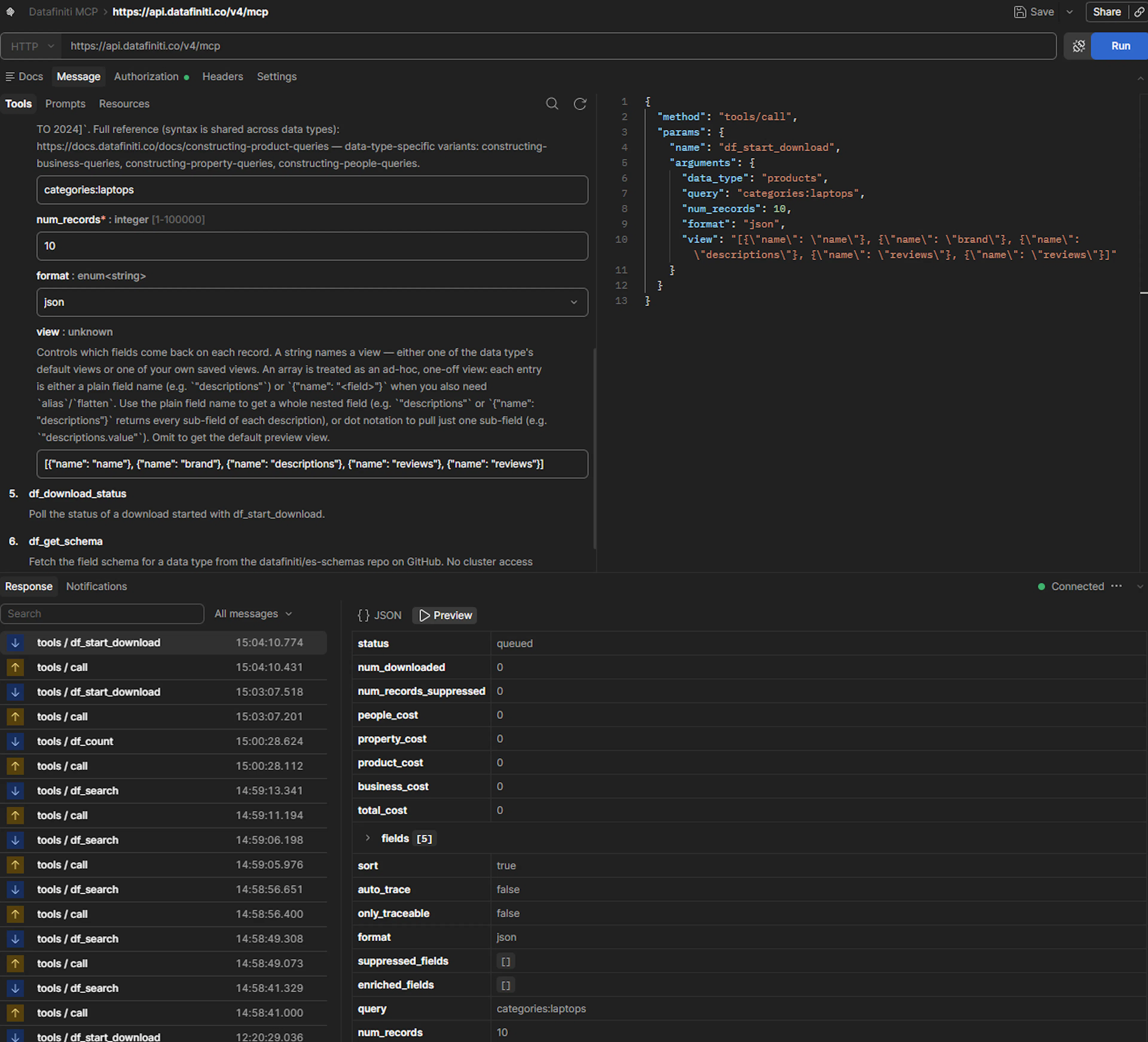
A common product use case is pulling descriptions or reviews in bulk. Select df_start_download and add a format:
{
  "data_type": "product",
  "query": "categories:laptops",
  "format": "JSON",
  "view": [{"name": "name"}, {"name": "brand"}, {"name": "descriptions"}, {"name": "reviews"}, {"name": "reviews"}]
}
It returns a JSON object with the new download id. Copy the id into df_download_status and poll:
{
  "download_id": "…"
}
The status comes back as queued, running, completed, or cancelled. Once completed, the response includes result-file links, valid for 7 days.
Download size follows your plan
How many records a download can return is governed by your subscription plan. To page a smaller set by hand, df_search returns up to 10,000 records across calls.
6. Try a product prompt
Select a prompt such as search_by_gtin, lookup_product_by_brand_model, or export_llm_training_data from Postman's prompt list. It returns a ready-to-run query; copy that into df_search or df_start_download to run it.
For the full list of product prompts, see Product Data with AI.
Next steps
- Same flow for Property, People, or Business.
- Setup and connection: Postman.
- Full tool reference: MCP Server.